


Strange creature straight out of a science fiction film, the gorgonocephalus or Medusa’s Head (Astrospartus mediterraneus) belongs to the class of Ophiuroidea, not to be confused with starfish. Its name originates from Greek mythology and means gorgon’s head.
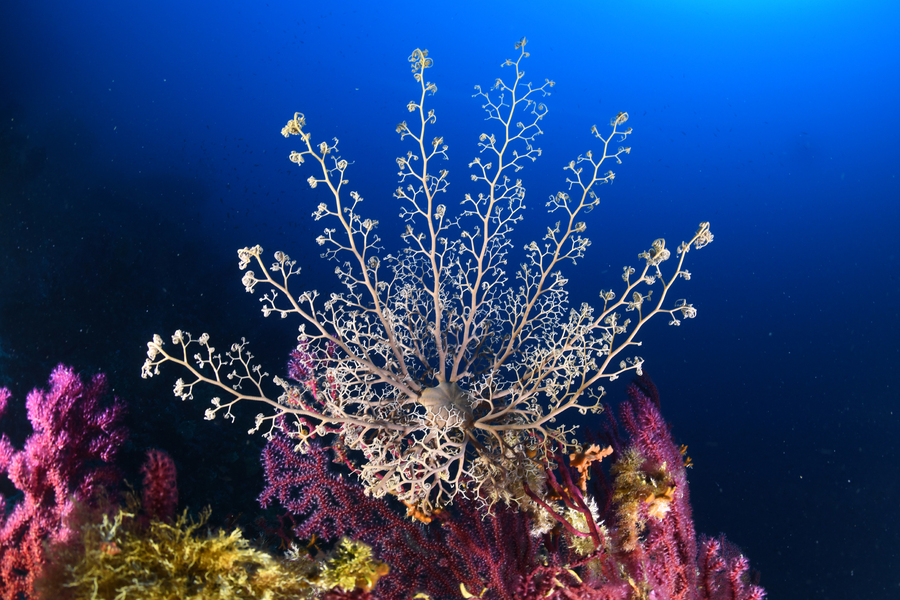
- A Mediterranean species: this benthic organism is endemic to the Mediterranean basin, where it can be observed from 50 to 800 meters deep.
- With a monster of the seas appearance: the gorgonocephalus forms a cluster, a gray lace made up of ten threadlike arms whose tips cling to their support. These arms unfold in the dark to catch suspended particles and their entanglement resembles animated hair. Its size can vary from 6 to 20 cm closed and up to 80 cm when spread.
- A peculiar echinoderm: among other ophiuroids, the gorgonocephalus stands out due to the significant branching of its arms. Five arms split into two arms, which in turn divide again, with increasingly finer branching.
-
Diet: each branch possesses small hooks forming a circular net that allows the Medusa’s head to capture its prey, mainly zooplankton. When present in sufficient quantities, the arms coil successively to bring them towards its mouth, a small opening in the center of the disk. This phenomenon can be observed in the morning after a nocturnal hunt.
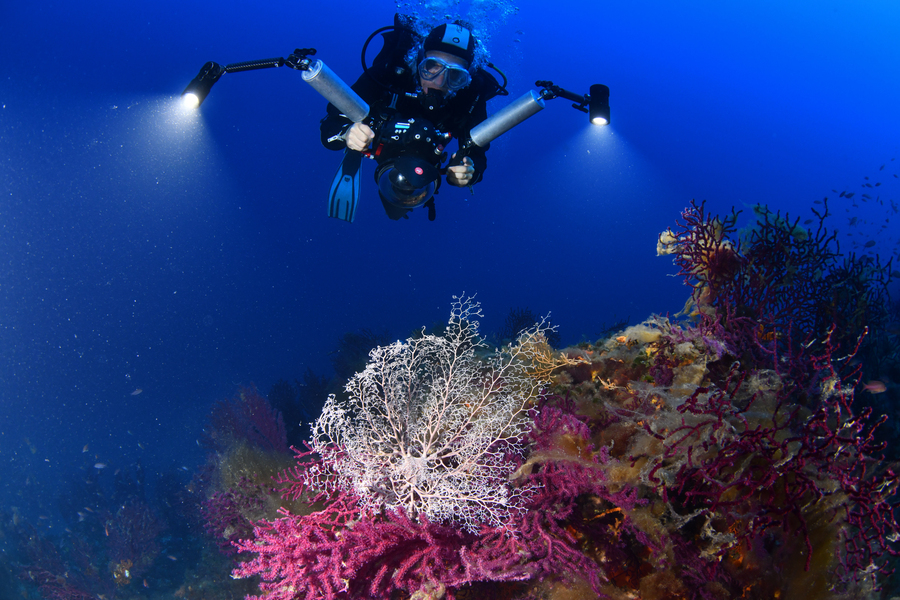
Gorgonocephalus on the Armoire reef off Hyères (Var). © Nicolas Barraqué - Sensitive to light: without eyes, the species is vulnerable, which is why the gorgonocephalus retracts at the contact of a light source. It is therefore strongly advised for divers not to shine light on it abruptly when encountering it.
- A release of newborns: gonochoric, the release of sperm and eggs occurs in the open sea. During their development, the planktonic larvae will settle onto a substrate.
- A mobile yarn ball: the gorgonocephalus is a relatively mobile echinoderm, it spreads perpendicularly facing the current and moves easily. In Le Lavandou, an individual has already been observed on a sponge at a depth of 90 meters.
- It regenerates: like a large part of echinoderms, such as starfish, the gorgonocephalus is capable of regenerating one of its arms and can live up to 35 years.
- An enigmatic species: the Medusa’s head remains little studied, mainly due to the depths at which it is found. Primarily circalittoral (between 70 and 120 meters deep), it often reaches the upper bathyal zones, where light intensity remains very low.
- New data thanks to Gombessa 5: in July 2019, the expedition of Laurent Ballesta « 28 days underwater at -120 meters » allowed the retrieval, among many other species, of pictures and more samples of the gorgonocephalus. These will allow for deeper insights into this species.
https://vimeo.com/418757935Where to find it? The gorgonocephalus is found in the western Mediterranean basin, the Atlantic, and North Sea, along the coasts of the Adriatic, Lusitanian, Mauritanian, and Senegalese regions. In France, it is notably found off the coast of Marseille, at Le Lavandou, Port Cros, and the Lérins Islands, where it attaches to rocks and gorgonians more than 50 meters deep.
Lisa Ferré